January 26, 2010

Web Marketing Vs. Trade Show ROI

IMG_4955.JPGOK - admit it, trade shows are fun. Sometimes traveling to a distant city, circulating with your peers, and dining out on the company can be a kick. You are learning too - about competitors and about your customers. The deadlines around a trade show can produce drama and tension, and some people thrive on that.
By comparison web marketing can be a daily slog and there isn't much direct contact with the customer. Web marketing requires persistence and patience. Success is metered in small steps and delivered incremental improvements over time.

In this article I explore who should prioritize shows and who should focus on web marketing and I share some ideas about how to compare the two.

I focus on these two activities because in most cases the best source of funds to drive growth in web presence is a bloated show budget. The palette of marketers is much broader - and the metrics used here can be used to compare the full range of options.

What's a marketeer to do?

Big companies are answering this question in different ways. Apple is shunning trade shows in education pretty much altogether (zero presence at FETC last week). Promethean had a campus sized booth, cheerleaders, and free gourmet cupcakes for all.

Who is right? As always the most important question to ask about marketing spending is "compared to what?"

In order to influence customers you need to be present in different media and locations (print, web, trade shows, catalogs, peer to peer, PR etc.). Customers lend credibility to companies they see popping up in different places.

A marketing budget is a series of compromises that should maximize visibility and revenue. One of the challenges in marketing is justifying visibility when there isn't a direct tie to revenue (i.e. when your CRM can't make a direct link). Depending on your circumstances both trade shows and the web can fall into this category.

I believe the relative value of trade shows has declined precipitously in recent years when compared to web marketing. That doesn't mean you should abandon shows, you just need to think very carefully about using them in the right way. At the end of the day what really matters is profitable revenue.

Lets dive into a pool of numbers to look deeper at this question.

McGraw-HillTrade Show Economics

Lets make some rough comparisons to get a sense of the relative worth of the two channels.

Consider a trade show with 5,000 attendees.

  • A company with a decent presence (a 20x10 space) might get 100 leads a day requiring follow up.
  • If the show goes 3 days this equates to 300 leads.
  • These leads will require sales time and energy to further qualify and in the end might be whittled down to 50 sales (1% of the attendees at the show).
  • The cost of attending the event will probably be somewhere around $20,000 (booth space, shipping, travel costs, entertainment, signage, drayage) with another $15,000 or so staff time in setting up the show, manning the booth, and then qualifying the leads and closing the business after the show.
  • Total outlay $35,000 and a cost per lead of $116.
Go to 10 shows and your annual show budget is $350,000.

With a gross margin target of 70% you need to make $1,000 per sale, or $500,000 to make these events revenue neutral. You should be promoting expensive products or reaching decision makers who buy in large lots to make these economics work. If your average order size is less than $1,000 you are losing money on the trade shows (using the lead/order flow assumptions above).

Scale this up or down - the basic economics remain the same. Go cheap and end up in the back corner in a 10x10 and your leads will drop and be lower quality. Glitz it up with rock star lighting and your cost per lead skyrockets along with the required revenue.

Non-Economic Benefits of Trade Shows

There are also non-revenue benefits to being at a trade show and these shouldn't be dismissed out of hand. You build brand awareness, network with other providers in the market, and provide support to current customers.

The most compelling benefit is that full fledged sales conversations can take place at the event itself. If decision makers (larger budgets, more influence) are present at a show then a low number of leads may not be as much of a concern, in fact the show may be an extremely efficient of way of meeting with large number of these folks in a short time.

In education this would argue for attending AASA but not IRA. The attendees do need to be walking the floor not playing golf, so your mileage will vary.

Another valid reason to attend a trade show is influence with the sponsoring organization. If the membership are important customers of yours it is good form to show up and support their professional association.

Brand impressions are less - well - impressive. Assume that 30% of the show attendees are paying enough attention when they walk by your booth that they get an impression. You will reach 15,000 people over the course of a year at a cost of $23 per. Yawn. At the end of the day (or fiscal year) top and bottom line results are all that count - impressions won't buy a cup of coffee.

One other thing - trade shows are moon shots. It is almost impossible to learn and modify on the fly - the event passes so quickly that if your show promotion or materials fall flat you have no chance to recover - until next year.


Graffiti in PragueInternet Marketing Economics

Now lets look at a comparable example for web site.

  • The company has invested a significant amount in building out their web presence using an outside contractor to do the heavy lifting which cost $200,000.
  • Amortize this over three years and your annual expense is $66,000.
  • In addition to this they have three people dedicated to managing the web presence for both content and technical infrastructure at an annual cost of $150,000.
  • Ongoing SEO and on-line marketing might cost another $15,000 a year.
  • Coding and contract design to tweak and extend the site might cost another $40,000 a year.
  • Total annual expense is $271,000.
  • Average daily traffic for the site is 700 visits with a 2% conversion rate to leads and 1% purchases.
  • On an annual basis this translates into 255,000 impressions, 12,775 leads, and about 6,300 purchases.
The cost per impression is $1.06, cost per lead is $21.31 and the cost per sale is $43.01. The breakeven cost per sale (using the same 70% gross margin) is $61.44 and annually $387,000.

Non-Economic Benefits of Web Marketing

The brand impression argument is much more compelling for the website - the cost per impression is a fraction of a tradeshow's ($1 vs $23) and the volume is higher.

Even better - the quality of the raw leads you get on the web are often the highest short of personal contacts from your sales force. I carefully chose the phrase "raw leads" because the downside of web leads vs. show leads is that they are unqualified - no one has talked to them yet to get a sense of how truly interested they are.

But - these customers are actively seeking you out when they search on the web and then put their hand up for attention. At a trade show most of the people who stop are just chatting - they were walking down the aisle and needed a break. This is one of the fundamental differences in on-line lead generation and all other forms (here is an extended post on this subject).

While websites generate leads at a slower pace, over time they greatly surpass tradeshows in high quality leads because the volume is so much higher. It isn't even a tortoise and hare story since the leads from a 3 day trade show are equaled on the web in 10 days (100/day vs. 31/day).

The Bottom Line

So lets break it down. The following chart maps out the examples I gave above.


Trade%20show%20vs%20web%20no%204%20metrics.jpg

From a marketing investment standpoint these are equal - the return to the company after the cost of goods and cost of sales is zero. But this isn't realistic for a specific company - it merely shows the price points at which each option starts making a net contribution to the larger business. Between $61 and $1,000 the web is going to be a much better deal for you.

Get Real

The key is to make this specific to your company. You do that by applying your average order sizes and gross margins for shows and the web and your specific metrics (costs, response rates etc).

Here is an example from an average of a few supplemental companies that I have familiarity with. Their trade show related sales are typically double what they earn on the web largely because a Rep is actively working them. BUT - even with the benefit of this difference they are losing money on trade shows and are wildly profitable on the web.


Trade%20show%20vs%20web%20No%203%20supplementa.jpg
To get to parity on the contribution margin if we hold the web order size at $250 the comparable trade show revenues need to be $4,000 per sale.

But what about gross margins - won't they affect this result? Somewhat - but order size has a bigger impact on this decision. If your gross margins are 90% you have a breakeven of $778 on trade shows and $48 on the web. If they are 40% breakeven is $1750 for shows and $108 for the web. The essential story doesn't change.

This example makes clear why Apple is shunning shows and Promethean is investing heavily. Apple sells tons of individual computers at something less than $4k with moderate gross margins while Promethean is mostly doing building or district level deals that bring in orders in six and seven figures with higher gross margins. The gearing all works in Promethean's favor for shows and in Apple's favor for the web.

In Conclusion

The conclusion is pretty clear - if your average order size is modest you probably should not be prioritizing trade shows (or you should be focused on dramatically increasing your average order size). Most companies should go to a handful of shows for the non-economic benefits - but choose carefully and scale your presence appropriately.

Don't be seduced by the work and "prestige" involved in trade shows - its easy to think that because you are busy and talking to customers that you are doing the most productive thing. Dig deeper - challenge your comfort zone on this.

Do you think about your web presence as a 24/7/365 trade show booth or is it something you feel like you have to do? Is it getting the same level of sustained attention that major events get?

Shouldn't it?

August 4, 2009

Harnessing The Power Of Story for Education Sales - Part 2

In this second of a two part series, guest blogger James Mayfield Smith responds to my post on Storyline in Textbooks and Video Games. James is an educational consultant, sales executive, and trained applied mythologist.

Part 1 can be found here.

Part 2 of 2: The Tactical Use of Story to Sell

By James Mayfield Smith


175sdcsdcsdcWhen done well, story can be an effective tactical approach for facilitating the buy cycle of a teacher or administrator. It can engage customers, humanize the sales process, build strong emotional connections, and stimulate passionate customer evangelists.

Lucky for us, the teachers and administrators who are
our customers long to hear stories and share them with others. We can engage them with the power of business narrative as we architect conversations about our educational solutions. Far more than simply telling the right story at the right time, such a process involves.

  • Getting clear about our own story of who we are as a company (and as an executive, regional manager, sales rep, etc.) and the value we bring so that we can be remarkable, as Seth Godin puts it.
  • Utilizing data to follow the breadcrumbs to the story that districts are likely to be telling themselves. This allows us to ask the right questions when engaging administrators.
  • Listening deeply to the needs of administrators and teachers, with the intent of discovering their deeper story of who they are and the underlying values that drive their decision-making. Such values are often very different, even for those who share a similar role across districts.
  • Asking the right questions to find the polarities that plague them. For example, do they need to boost test scores with students who are on the cusp of proficiency, but lack dedicated staff to implement an intervention? Identifying the duality of where they are being squeezed is one effective approach to finding the precise lever that will close a sale, especially during tough budget times.
  • Engaging our customers in genuinely relevant dialogue at each stage of their buying cycle. It’s the district’s buying cycle that determines the timing and outcome of the deal. We can facilitate targeted decisions at each stage to keep the purchase moving forward. In contrast, when a sales rep has entered “Presentation made. Awaiting decision.” into the CRM system and doesn’t continue to facilitate the buying cycle, odds are that the purchase may stall with a key contact who is overburdened with other decisions. We can bet that a competitor is moving their own deal forward to take the zero-sum dollars from the budget that might otherwise fund our solution.
  • Using business narrative techniques (a.k.a. stories and conversations) to facilitate and co-create a shared future story featuring our customer as the central character and our company as a solution provider that meets their specific needs.
Find The Right Tool For the Job At Hand

At different stages of the buying cycle, such stories will look very different. Some stories are simply brief conversations. Others are facilitated by the salesperson and told by the customer, with a focus on the administrator or teacher feeling heard and important information being discovered. The intent of the conversations and stories are to move the buying cycle forward towards a solution that meets the need of the district and provides lasting value.

These types of stories might include:

  • The Expectations for This Meeting story
  • The Curiosity Arousal`story
  • The Company Founding story
  • The Why I’m Different Now (Transformational) story
  • The Who Are You and What is Your Pain story
  • The Consequences of Not Changing story
  • The Greater Possibility story
  • The Why I Care about This and Can Serve You Well story
  • The Fostering Safety and Managing Risk story
  • The How to Move Forward story
  • The Cost and Benefits of the Solving this Problem (Price) story
  • The Winning over Other Key Decision Makers story

Although a seasoned sales professional will immediately recognize the conversational value of such stories, each of these uses of story deserves an entire blog post of its own. For more information, the innovative financial planner and author Scott Farnsworth has done some excellent work in this area and provides a good
explanation of how to use such stories for sales.

In Conclusion

As educational publishing professionals, we can harness the power that story offers as a vehicle for change. We can utilize story to help us serve educators, students, and our own organizations, and we can do so in ways that our minds and hearts are designed to do and even long for.

On a tactical level, you don’t have to be an applied mythologist to appreciate the benefits of utilizing story to generate revenue. Using powerful conversations and stories to help sell is an ideal approach for educational publishers.

Part 1 The Strategic Use of Story to Sell of this two part series is here.
Lee’s original post Storyline in Textbooks and Video Games is here.

September 29, 2008

An Education Consultant Speaks - School Sales & Marketing 101 Part 2

ertydfhcghDo you need to pick a target market when entering the education market? One of the true signs of a rookie is a business plan built on selling to all schools. Just because all schools should be using your widget doesn't mean they are ready to buy it.

Picking a target market is a discipline many people try to avoid - they don't like getting boxed in. Others don't understand just how big the education market is or think all schools are the same. If you are in love with your product you may resist the idea that some schools don't want it or don't need it.

Today we tackle issue #2 in our series on selling and marketing to educators. As a consultant in the education market I work with a wide range of businesses. This series covers the common execution errors I see with new executives and companies when they enter the market.

Part 1 is here.

900575_button
Part 2. "Education" is not a target market - it's an industry.

Education is a vast enterprise. In almost every community the school system is one of the top 3 employers. Thats right - every community. In the US education is second only to defense in total spending.

A target market is a niche, an industry segment that is particularly friendly to your story and solution.

Picking a niche to target (which I've written about here and here) is not complicated. Schools vary widely in their infrastructure, politics, test scores, pedagogical preferences, and budgets. Your goal should be finding enough low hanging fruit to keep you busy as you build your business without overwhelming your capacity.

If you are selling education technology - find the schools that already have the infrastructure to run your product. Otherwise you have to first sell them a bunch of someone else's stuff.

If you have a hot new reading product find the schools with the lowest reading scores - they are motivated to look for something new.

If you are capital constrained limit yourself geographically to keep your costs down. Build out from there.

If you focus on a particular pedagogical philosophy the presence of similar or related products should be a green light.

You also want to make sure you go where the money is.

In many cases you will pick from all of these. Lets say you have a new reading intervention for middle schools. To keep your average sale high you might want to target large middle schools with bad test scores and funding to address it. If you are in Newark you may want to focus first on your home state to keep costs down.

How do you find the data to help you focus?

I use a tool called MarketView from MDR which makes it easy to ask questions like "how many middle schools in New Jersey are missing AYP and have more than 500 students?" The answer is 107. This is a critical number for business planning (market size, share projections, revenue projections, sale force capacity, etc.). I could also easily create a mailing list and a call list for a Rep from the results of this search.

Scholastic's QED division also has resources and services to help you answer these kinds of questions.

State DOE websites are a great source of data. For example California has lists that allow you to drill in deeply on test scores by school, district, or county.

These quantitative qualifiers are a starting point - you then start calling on these schools and asking the questions you can't get answered from a database (e.g. what pedagogical approaches do they favor?, is this issue a priority for them this year?, do they have complimentary products etc.). By narrowing the list and then qualifying further you spend the most precious asset wisely - your time.

You can do a lot of this yourself if you choose to - but in many cases a seasoned hand can shorten the distance between your product and the right customers. But please - no matter how you approach this question pick a market to focus on.

A side note - unless your product is specifically designed for private schools or the home school market don't prioritize them initially. They are relatively small and highly fragmented markets. Public schools are 90% of the opportunity. This isn't an editorial on the merits of either market - just a dollars and cents suggestion to maximize your investments of money and time.

School Sales & Marketing Series

Part 1. Obey the calendar. Schools buy on a regular schedule, design your business around it.

Part 2. "Education" is not a target market - it's an industry. No matter how great your product you need to pick a target market to focus on.

Part 3. This is a zero sum game. In order for you to win someone else has to lose.

Part 4. Teachers don't have the time to take the rough edges off your product. Teachers make or break a product.

Part 5. It's all about learning - mostly. You need to know the politics of selling to schools.

November 5, 2007

10 Ideas to For Marketing & Selling In The Age of Information Overload - Part 4

893383_megafone

Marketing and selling in the era of infinite input feels like howling into a gale. The average urban dweller is subject to 4,000 ads a day, 1 every 14 seconds. The only sane defense is to tune it all out, to turn it into wallpaper for your world.

Earlier in this series on Information Overload we looked at our broken paradigms of information management, a new personal productivity paradigm, and 10 ways to build instructional products for today's learners. Today we look at what this means for those of us in the persuasive professions. The suggestions here are not just for education publishers - they are what I consider best practices for all marketers.

The fundamental problem is that the signal to noise ratio has gotten completely out of whack. I have an email account that I've been using for several years. Spammers have gotten their grubby little mitts on it and I now get over 3,000 spam emails a week at this address. I have great filtering - less than 100 make through so that isn't the problem. The issue is that I no longer bother looking for false positives - I just delete it all and hope/pray that if it is important the person will find another way to reach me.

So what is a legitimate marketeer to do? Here are some suggestions for how to rethink your marketing and sales mix so that you can stop shouting and start conversing with your customers. Fundamentally it is about what I call Socratic Marketing.

I'm assuming you have read at least the first installment in the series, what is below will make more sense if you have.

Marketing & Sales Concepts For The Conversation Economy

1 - Be remarkable - You should have a winning promise and make sure that everyone in your company understands their role in making it real. Do something worthy of sharing with other people and customers will find you. Seth Godin writes consistently and persuasively on this topic. This is the bedrock of the new approach.

2 - Stop shouting. You can't have a conversation when you are screaming. Beyond the obvious (opt-in lists) you need to look at every communication and ask whether it is relevant, important, and actionable for the target audience. Make sure you hit all three. With the time you save from implementing the ideas in Part 2 listen more. With social media, blogs, and wikis It is so much easier to do today that you have no excuse.

3- Respect people's time. Less is more. Here is a great example.

4 - Be there when the customer is ready. Post information on your web site that maps to different stages of the sales cycle. Initially have general comparison charts that help prospects form a mental map of the market. As they get closer to buying have the detailed specs on hand. After they have purchased send at least one message with tips on how to get the most out of the product.

886341_misa
5 - Relax Grasshopper - This new information economy is not kind to control freaks. The goal is to help your passionate users find ways of communicating with their peers - what they have to say is going carry a lot more water than anything you say. That said, if you open up communications with customers you lose control of some of the content and some bad stuff is going to crop up. This is really an opportunity to engage in conversation. Would you rather they complained behind your back where you can't respond? In the end the benefits of openness far outweigh the negatives.

6 - Make it personal - In a sea of corporate dreck people respond to the genuine and personal. Boeing's Chief Marketing Officer has a blog, Randy's Journal. This forces a more honest interchange - he is speaking from his own perspective. It allows him to talk about issues that he has expertise on (e.g. the fabled 7 extra inches of cabin width on the Airbus translates into a pencil width for each seat). People expect you to have a perspective but they also respect the expertise you bring to their information gathering.

7 - Stir up some channel conflict. In an era when all the rules are changing and no one knows for sure what is going to work you had better get comfortable with channel conflict - you have to try a lot of new things to find what breaks through. Put a few products in on-line teacher communities like We Are Teachers [client], allow customers to build custom bundles on your website, or publish something just for the on-line world.

352262_hiding

8 - Don't hide information with the hope that you are going to "force" the start of a sales conversation. You will just frustrate customers who are used to instantly finding what they need. In fact - go the opposite direction and constantly fine tune your site to increase your pageviews and make sure that the navigation is as intuitive as possible for the largest number of users. Don't manage your website as a job protection scheme for your sales reps - you don't do them any favors by pissing prospects off early in the process. If it is a complicated sale the customer will want to talk to a Rep.

9 - Worry more about communicating with your customers than about your competitors. Don't kid yourselves that the competition won't get access to information if you hide it - after all you get your hands on all the competitor's info - don't you? In a world where information flows so easily it will find its way out whether you want it to or not. The only person you will really inconvenience is a prospect.

10 - Its the Web Baby - Optimize. Take a hard look at your web site and the various search strategies customers use to find you. Are you at the top of the search results every time? Do your writers know how to load up searchable text in your titles, tags, and the first paragraph on each page? Is your copy tight, punchy, and hyperlinked where needed? When a customer gets to a product page is there more there than a part number and a price? Measure your results on everything and move resources towards what is most effective, even if it seems counterintuitive.

We hope these ideas help you get started on the road to building a robust conversation with your customers. To find the budget I suggest you downgrade trade shows and invest the savings in on-line presence. Most organizations continue to invest far too much in trade shows out of inertia. Think of the new stuff as building a 24/7/365 trade show booth if that makes you feel better.

If you have tried some of these ideas or have additional tips to pass along comment away!

Information Overload Series

Part 1 - It’s all in your head - really
Part 2 - A cure for “a poverty of attention”
Part 3 - 10 Ways to Build Instructional Products For 21st Century Skills
Part 4 - 10 Ideas to For Marketing & Selling In An Age of Infinite Input
Summary - Closing Thoughts and Resources

October 12, 2007

eMail 2.0 Resources for Education Marketing

E-Mail Marketing to Educators: What`s Working was put on Heller QED on October 12th. I had the honor of speaking about eMail marketing in a web 2.0 world.

808857_figures_arroba.jpg

My core message was that eMail 2.0 is activity driven, not demographics driven.

A person does something, and the company responds in a personal, authentic, and timely manner with a communication. It has the same give and take as a conversation. The focus is engaging people early in the decision making cycle with useful information, not at the end with a last ditch special offer.

As a follow up to the call I've assembed the following list of resources for attendees. I've also included my presentation for those who were unable to make the call.


Presentation

My presentation (PDF) Download file from today with speaker's notes included.


Articles

A couple of really good articles that lay out the case for the conversation economy.

The Conversation Economy - Business Week

Internet Marketing Mind Map - very cool


Books

These are all books that will build background knowledge and understanding of the larger trends that are at work today in the marketplace.

Wikinomics

The Long Tail

The Wisdom of Crowds

Naked Conversations: How Blogs Are Changing The Way Businesses Talk With Customers

Small is the New Big


Business Blogs

All of these blogs touch regularly on issues related to marketing in a web 2.0 world.

Logic + Emotion

Seth Godin

The Long Tail

Bokardo Social Web Design

Copyblogger

Marketing and Strategy Innovation Blog

Influential Marketing Blog

Education Business Blog


Educator Blogs

These blogs won't teach you about email or marketing - but they will show you the kinds of conversations educators are having in general. These are some of the best but there are thousands out there to sample from.

eLearnspace

Weblogg-Ed

Not So Distant Future

Classroom 2.0


Metrics Tools

These are all tools that will help you measure traffic and activity on web sites. Some are free, some are not.

Quantcast

Comscore

Hitwise

Compete.com

Google Analytics


Service Providers and Autoresponders

These are companies and products that can help you set up your response trees, manage the process, and track performance metrics.

Skylist

Intellicontact

Aweber

Send Studio

Eloqua

You can also build a lot of this directly into your website if you choose to.

July 18, 2007

Target Market Selection

Picking a target market is one of the most fundamental decisions a sales and marketing team makes. Your target market determines what products you build, where you promote them, and how you talk about them. Socratic Marketing in the budding conversation economy demands a rigorous approach to this question as part of your Big M Marketing approach..

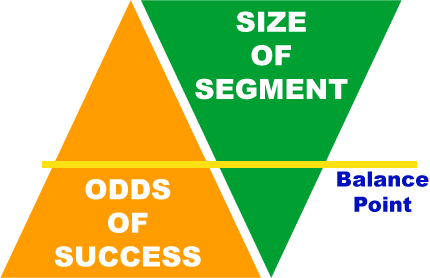
Target-Market-Forces.gifPicking a good target market is a balancing act. The smaller your market the higher your odds of success in targeting specific needs. However, that has to be weighed against the financial objectives of the business. You can’t get so small that you define yourself out of a job! Think of this as two forces that are inversely proportionate. Your goal is to find the right balance point.

So why do so many companies get this wrong? They define markets based on granfalloons, a concept coined by Kurt Vonnegut which means "a proud and meaningless association of human beings." For example, have you seen segmentation schemes based on geography, district size, or % of free and reduced lunch students? If you are engaging in data driven selling and/or socratic marketing these are good starting points, but they are not the most powerful way to define a market.

A far more effective approach is to define your market based on how customers think about their problems. After all, in a conversation economy their problems are the topic you will discuss with them. “Fine,” you say, “but I can’t look inside their head to see how they think, I can’t measure that to determine if the market is big enough.” Fair enough, but if they really believe something their actions will speak louder than words. You can observe where they spend money and time to tease out what their priorities are.

davis_airflow_tels.jpg On a sail there are dozens of tiny strings, tell-tales, woven into the fabric that show how the wind is moving across the face of the sail. This allows the sailors to trim the sail for optimum performance. As a metaphor this works perfectly for the concept we are after here. We can’t see how our customers think, but we can observe decisions they have already made to get a sense of it.

For example, at Chancery when we released Open District in the mid 90s we decided that only large districts would be open to purchasing the product so we didn’t even bother setting up pricing for districts with fewer than 10,000 students. Almost immediately however our Sales team was telling us that smaller customers were interested. When we dug a little deeper we found that it was far more important how customers saw the role of data in decision making than how big they were. The tell-tale we used to determine this was whether or not they had hired a Database Administrator (DBA) to manage their IT systems. This allowed us to be far more precise about our targeting while expanding our footprint at the same time.

On the curriculum side you might have products that appeal to constructivists or to advocates of guided reading. For the former you might look to see if they are using any products from members of the Constructivist Consortium. For the latter it might be relevant if they have maintained a librarian on staff or if they have a bookroom. Your products might require a fair amount of teacher training - look to see how they are allocating their budgets in this area. If you are selling technology you might key in on whether or not they have installed electronic whiteboards.

The goal is to find a handful of tell-tales that marketing and sales can use to focus their efforts. Marketing can use it for list selection (only give us Districts with a DBA) and Sales can use it to qualify prospects (check - they have whiteboards).

690472_bulls_eye.jpgIn the end the way you define your target market should be unique to your business but it should go much deeper than superficial indicators. Your goal is find a group of customers who are thinking about their challenges in ways that make them particularly open to the solution that you are offering.

May 9, 2007

Data Driven Selling in K12 – Quick Start Guide

It is easy for a sales force to fall into a comfort zone. Data-driven decision making techniques can help insure that Reps are reaching beyond their current contacts.

In many companies there is a great deal of data about the market. The challenge is to drive this into your field organization so that the Reps and their Managers are probing for untapped market potential on a regular basis.

There are some simple and quick ways to start using data in selling to schools and school districts. This post outlines some ideas for how to encourage your sales force to adopt a more data driven approach.

More below the fold…

Continue reading "Data Driven Selling in K12 – Quick Start Guide" »

Bookmark: Bookmark Data%20Driven%20Selling%20in%20K12%20%E2%80%93%20Quick%20Start%20Guide at Google.com Bookmark Data%20Driven%20Selling%20in%20K12%20%E2%80%93%20Quick%20Start%20Guide at del.icio.us Digg Data%20Driven%20Selling%20in%20K12%20%E2%80%93%20Quick%20Start%20Guide at Digg.com Bookmark Data%20Driven%20Selling%20in%20K12%20%E2%80%93%20Quick%20Start%20Guide at Spurl.net Bookmark Data%20Driven%20Selling%20in%20K12%20%E2%80%93%20Quick%20Start%20Guide at Simpy.com Bookmark Data%20Driven%20Selling%20in%20K12%20%E2%80%93%20Quick%20Start%20Guide at NewsVine Blink this Data%20Driven%20Selling%20in%20K12%20%E2%80%93%20Quick%20Start%20Guide at blinklist.com Bookmark Data%20Driven%20Selling%20in%20K12%20%E2%80%93%20Quick%20Start%20Guide at Furl.net Bookmark Data%20Driven%20Selling%20in%20K12%20%E2%80%93%20Quick%20Start%20Guide at reddit.com Fark Data%20Driven%20Selling%20in%20K12%20%E2%80%93%20Quick%20Start%20Guide at Fark.com Bookmark Data%20Driven%20Selling%20in%20K12%20%E2%80%93%20Quick%20Start%20Guide at Yahoo! MyWeb


If you enjoyed this article, subscribe to the RSS feed for regular updates!