February 11, 2012

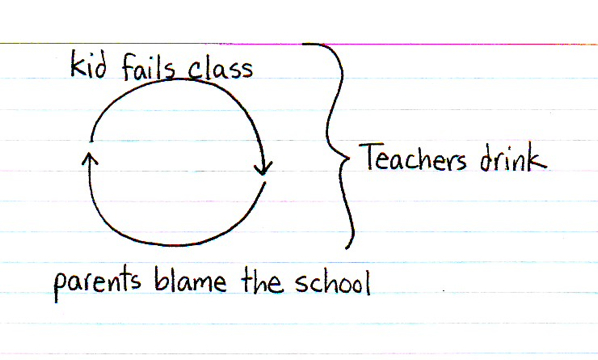
Education Reform Explained

UPDATE: For those who took offense at this graphic know that as I saw it the teachers' drinking was a result of the cycle, not the cause. I interpreted this graphic as a slag on parents (myself included). If you are a teacher and were offended please accept my apology. If you are a parent and were offended - go volunteer in your local school. Regular readers will know that I have nothing but the highest respect for teachers.

One simple graphic from the always brilliant Jessica Hagy untangles the whole complicated mess.


Nuff said.

January 6, 2012

5 Reasons Numbered Lists Are Stupid - Friday Curmudgeon

IMG_0245Numbered lists on blogs are all the rage, particularly at the turn of a new year.
Since mid December my RSS feed has been stuffed with 10 best if 2011, 20 ways to do that, and 12 things to look for in the new year. Oh February please come soon.

If you find yourself falling for this brand of year-end-birdbrainery consider the following 5 points.

4. Lists Are Cliche

At this point there is nothing original in banging out a list. Do you want your blog to stand out for original content or do you want to be just another hamster on the wheel?

2. They Are Cheap Salvation

Reading a list about making your life better is just like making it better - only quicker and easier. Right?

5. They Are Arbitrary Link Bait

I scanned "30 Ways to Make Your Life Better" and wished the authors had taken the brain power to consolidate down to 3. Instead they dumped a truckload of self-help books in a messy pile.

Yeah, shame on me for clicking on it.

3. Forwarding Them is Passive Aggressive Advice Giving

If you want to make your point with barbed humor use the content over at Passive Aggressive Notes. We are all Amy Misto.

1. There Is More - buy why bother.

Don't say you weren't warned. Now, where is my TPS report?

Unknown

Alright kids, get off my lawn.

OPOL

September 21, 2011

Gamification Is A Stupid Fad

level-32-nerdThere are bad ideas that become iconic for every era because they were popular fads. Pet Rocks, the Pacer, Supply Side Economics, and .com groceries all come to mind.

Looking back we all scratch our heads and wonder - why?

Gamification, ripping the reward and recognition systems out of video games and applying them to behavioral modification is likely to stand in for our current times in the future.

In the attention economy everyone wants stickiness, products that get used a lot. Some of the stickiest products ever invented are video games. World of Warcraft has a whole genre of humor dedicated to how obsessive players are. The list of sticky games is long, Whyville in education and it's many spawn like Farmville on Facebook come to mind.

The most common elements in gamified applications are:

  • Achievements and Badges
  • Leader Boards
  • Progress Bars
  • Virtual (or real) Currency
  • User Challenges
Gamification is all the rage right now with entrepreneurs and VCs. They are building products for wellness and health, email management, location awareness, sleep management, homework, to do lists, prayer, and just about any sphere where people want to change themselves or manage processes that are boring.

Please make the stupid stop.

Personal Experience

The opinions expressed in the column were earned through experience. Like many in the education game community, I was initially excited about extending the power of games to other contexts. But as I used these tools I found that they could spur a week or two of use but they lost their punch quickly and faded away. After the 5th application the pattern started to emerge.

I've been using. Weight Watchers excellent iOS app for a couple of years now. It is useful and well designed with plenty of what could be considered game like elements. But it is not a game. Tracking your food necessary for success but is still a chore. I never stayed up until 1 AM trying to get to the next level of weight loss (hmm but maybe I should...).

Based on my experience there are three fundamental errors that underly the rush to gamify everything.

You Are Unique - Just Like Everyone Else

The first error is assuming everyone responds the same way to game mechanics. There is quite a bit of literature on the different styles of gameplay most of which builds on Richard Bartle's work. Anyone who has spent a meaningful amount of time in the on-line game arena quickly identifies with Bartles four categories of Achievers, Explorers, Socializers, and Killers.

Simply put. gamification only works on a sustained basis for a subset of the population - it is not a universal panacea. Not only that but the Achievers often play for the recognition of the other groups - so only focusing on this one group omits the necessary context of Achiever's motivation.

Systems Theory

The second error is assuming that you can separate the reward system from the other elements popular games and have it work. Non-gamers, most of the people throwing time and money at this problem, see the reward systems in games and make the assumption that you can simply repurpose the badges and achievement trees elsewhere.

If you took a steering wheel and handed it to someone who knew nothing about cars they could describe in great detail what it is. It is round, hard, ridged, has a stem, and there is a large bag packed into the center. What they couldn't tell you is what it does. Context matters for true understanding.

Why is it round (human arms), why is is it ridged (human fingers), what does that stem do (control of other front end systems), why is that bag there (human lives). None of those things make sense without understanding the human and other machine components of the larger system.

If you want to understand game reward systems you need to play a lot of games so you can grok the context.

Conversely if we hired a master mechanic and told them to go buy the best example of every car part we would not end up with a functioning automobile. Systems design also has to apply to context. Our steering wheel has precise dimensions so that it attaches properly to the steering column and provides proper sight lines to the speedometer.

Bolting cutting edge game mechanics onto bleeding edge mobile apps does not a useful thing make (usually).

Remove reward systems from games and you do not have a functioning mechanic. Even an extremely well designed gamification system out of the context of the rest of the game has no sustainable use. You might get short term gains but only the obsessive compulsive Achievers will stick with it. (That is a market segment, but not the one everyone is shooting for.)

Game Contexts

There (at least) three contexts in games that interact with the reward elements in ways that make the overall system work. The true value lies in how the components ALL interact. I will refer to these as components but in practice they are nested systems themselves with their own internal dynamics.

Narrative context - scratch 90% of gamers and they tell you that they engage with the story line of the games they play. In a casual game it may just be that the birds are angry, in an MMO it may be an intensely co-created universe like Eve Online. Since so many of these involve elves and rescuing princesses or invading alien bugs non- gamers too easily dismiss what they see as silly window dressing. Don't. At one level the reward system is the marker for your progress through the narrative. It makes the immersion more immediate and reminds you of how far you have progressed.

Social context - we are social and competitive beings. These two elements are linked. It is hard for me to sustain competitive fervor against people or groups that I am not socially close to. Trust me on this one, I'm a Red Sox fan. Or pick any college rivalry. Why is Words With Friends so compelling? What keeps people playing World of Warcraft for years on end? It is the relationships and the rivalries, some friendly some not, that emerge from playing together. Competing with random strangers to be "mayor" of a local coffee shop isn't a sustainable business model. The novelty wears off and we drift off to places where we can truly interact with other people.

Fun context - last but not least game reward systems are situated inside of an activity that is fun. Taking a boring chore and bolting game mechanics on it doesn't make it any less boring or any less of a chore. Put another way, sober up a horse thief and you've got a sober horse thief.

In many ways these relate back to the other three categories identified in Bartle's work - Explorers like engaging with the narrative, Socializers revel in schmoozing, and Killers play for the joy of offing competitors. All rely on the presence of the others to get the full experience.

Conclusion

Education and learning in a school setting is a long term project not subject to quick fixes and panaceas. It would be a mistake for Education Publishers to embrace gamification without the larger contexts of games. I passionately believe games can make a huge difference in learning, but we need to embrace all the elements for it to work.

I'm not saying reward systems can't be well designed , but you can't just take the game elements out of context and have them work on a sustainable basis.

August 12, 2011

Getting Social Media Precisely Wrong

Sign Danger Two Way FeedI just got back from two weeks off, really off as in "I read 6 books" off.* The whole family sat on a chilly island in the Northwest and just let the old mazooma roll in. I highly recommend it.

My time away generated the germ of a couple of meta posts about publishing in the era of social media. But, before we get to that I saw the worst use of social media on on my flight out. If there were social media police these guys would be doing hard time.

I use an off-site parking lot when I travel. They get all the fundamentals exactly right - there is always space, you are always picked up within 1-2 minutes, they are clean, drivers are pleasant etc. etc. They normally bring their A game to everything they do.

But as I sat there groggy at 4:30 AM on the shuttle bus I noticed a poster in the shuttle bus that made my jaw drop. The photo below isn't all that good so I'll summarize the headlines here.

"We're Social

  • Like Us!
  • Tweet Us!
  • Watch Us!
  • Connect with Us!
  • Check In Now!
  • Show Us Love!"

Social Media Mistake
What is missing from this picture? Certainly not exclamation points.

Not once do they mention the customer or give them a reason to do anything - it is all about them. Why would I tweet them? People who tweet at the level of "just parked my car" earn the ignore button. Why would I watch them on YouTube? Seriously - are they giving lessons on how to park? To save y'all the pain I actually looked up their YouTube video and as I suspected it is nothing more than an advertisement.

This is the old media mindset at work in the new media. You can just see the cigar chomping VP of Marketing shouting "Get me eyeballs!" and the team scrambling to get webstats showing traffic, any traffic.

But social media is a two way street. You must give people a good reason to interact with you and you need to conduct a respectful conversation with them when they show up. Nowhere should you be taking about yourself.

So in the spirit of bringing solutions rather than just whining here is what I'd do. Each of these suggestions could be employed by any company.

  • Focus on the services most likely to generate business - on this list only Yelp really comes to mind. Send an email to frequent parkers the day after they get home with a Yelp link asking for a review. Then respond to the reviews (good and bad).
  • Tweet regularly on airport conditions - busy, calm, delays, etc. - give customers a reason to pay attention to your feed.
  • Allow the members to link their frequent parker cards (yes they do that well) to social media and then give them awards for every 5th or 10th use of the card that is broadcast to their network. Give your customers bragging rights.
  • Create some videos with truly useful information for travelers (links to cool packing software, tips on how to pack light, information on when the best times of the day are for security lines, etc.). Skip the ads, provide a service.
This isn't that hard - but you have to get out of the "me me me" mentality of advertising.

Now, go make yourselves useful to a customer....

--------
* For the curious this was true vacation reading not high lit - 1 from Ian Rankin's Inspector Rebus series and 5 from the Lost Fleet series by Jack Campbell.

July 18, 2011

The Internet Is Making Us Crazy - Like A Fox

1254880_shiny_brain_Is the Internet making us dumber or are we just using our brains in new ways? The BBC posted a great overview of a new study which makes the case for a neat trick the brain is pulling now that we have 24/7 access to the web.
The article notes:

"When participants knew that facts would be available on a computer later, they had poor recall of answers but enhanced recall of where they were stored.

The researchers say the internet acts as a "transactive memory" that we depend upon to remember for us"

This jibes with my own experience over the last decade. Memorizing facts and dates is so 20th Century. Bottom line - this mental strategy frees our brains up for other work.

When it comes to designing education media this has huge implications for every aspect of the products that come out of our industry. Design, marketing, implementation - all need an overhaul in light of this one simple concept.

This is part of why I'm so excited to be participating in the Learning Resources Metadata Initiative (LRMI) as a delegate from the publishing industry. I'll be writing more on that in the coming months as the project gets off the ground.

Start your week on a positive note and go read the BBC's article.

July 14, 2011

Facebook and Twitter Marketing Economics - Cynic's Corner

Wrong Way Go BackThere is a profitability model for companies promoting themselves on Facebook and Twitter. There a lot of people making good coin from the incessant flogging of companies and organizations in social media. It just isn't the companies themselves who are profiting.

Here is how it works in four easy steps:

  1. An executive is at the dentist's office and sees the plea to friend and follow them. A dim light bulb goes off - "we should do this too." Lemming marketing almost never works, particularly when you are following behind your Dentist.
  2. Someone in Marketing with an advertising background is assigned the task of building a following in "social media." This is so important that they are given a bonus. The performance metrics are the evil stepchildren of the "brand impressions" school of marketing metrics. Quantity over quality.
  3. A campaign of whinging pleas to friend and follow ensues. We see this in every piece of literature the company products (annual reports - really?), at trade shows ("it only takes a minute!"), and even on flashing freeway signs ("great idea, let me do that while I'm driving..."). Logrolling and sock-puppetry are rampant - many of the "followers" are marketing people at other companies playing the same game.
  4. The metrics are hit, the bonus is paid. PROFIT!
This whole scenario is so wrong on so many levels it makes my teeth hurt. Here are some thoughts to help reframe this approach that map back to each stage of the process above.
  1. Any executive who is in a position to affect social media policy must be an active participant themselves. This doesn't mean a LinkedIn account with 8 connections. They should be on at least 3 different services. A deeper understanding of how social media differ from traditional media has to be earned through experience - it is the only way. Put another way - they should intuitively grasp how empty the Dentist's little social media campaign is.
  2. If you are going to build metrics organize them around engagement not exposures. The advertising paradigm of quantity over quality is precisely the wrong mindset to bring to this gunfight. Social media is all about a small number of high quality conversations not a bloated mass of easily ignored screaming.
  3. Social media should be all about attraction rather than promotion. DO things that contribute to the on-line community and you will be rewarded with a growing network. "Followers" is failure - remember this is about engaging in a two-way dialog. You have to make a real investment to make a real contribution.
  4. Everyone involved has to show a little more patience than they are used to in a transactional marketing model. If you are used to big bang marketing events you need to see how 2 new followers a day over the course of a year add up to a hell of a lot more than 100 leads from a trade show. It isn't as dramatic, but the impact is far greater.
Go forth and prosper.
May 4, 2011

Idiot Alert

moran-7512Email marketing is pretty simple - as much as possible communicate with people who want to hear from you. But a subset of these folks just don't get it.

If I go to the trouble of clicking "unsubscribe" please do not send me ANOTHER FRICKING EMAIL CONFIRMING I NO LONGER WANT EMAIL FROM YOU.

It insures that I move from the "mildly annoyed" column to "actively pissed off at your company" status.

I'd put their names up - but that would only encourage them. No links for dinks.

Sheesh.

February 2, 2011

Social Media Ecosystem - Hamsters, Owls, Frogs, Hyenas, and Ostriches

Social media mirrors the dynamic features of a natural ecosystem. Which niche you are going to fill? Here are four examples with loving snarkitude - feel free to add more in comments.

Hamsters constantly post small updates on every aspect of their life. Favorite habitats are Twitter and Facebook. They eat any small scrap of feedback up. Want to know what they had for dinner or what their kids did this afternoon? They will be spinning along on their wheel of self-absorption assuming the whole world is fascinated. If you are a dear friend or a family member I might be interested in this - in small doses. If you are an acquaintance - not so much.

Owls save their powder for long blog posts on their theory of life - posting infrequently but weighing down your RSS reader with dense prose. Favorite habitats are Blogger or their own bespoke blog. They eat spam comments by the barrel and sustain themselves on the infrequent genuine comment that validates their sense of importance. They sit on the Internet's roof and hoot out who, how, and why? But really - why?

Frogs eat small meals all day long, hop around a lot, and don't contribute much. They are quite flexible in habitat - able to survive in almost any media environment that has a steady stream of content. In search of sustenance they will be constantly moving between services scanning and clicking but never adding much to the conversation. Someone has to eat all those flies - but just remember what they flies themselves eat.

Hyenas are scavengers who constantly rebroadcast others' content. Their habitats are YouTube, Scribd and other environments where pirated content flows freely. They eat the sweat of other people, adding a snarky sentence or two as needed. Copyright law is for suckers. The Lion King had their number.

Ostriches assume this whole thing is a fad and stick to their paper address book. Favorite habitat is the 1970's. They eat Filofax pages and any bad news about social media. Most reporters at traditional media are Ostriches. Or Dodos. Extinction looms.
Most of us move around a bit - particularly as our social media perspective matures. Many people start as Hamsters and over time move to Owls or Frogs. Some dive in - discover they don't like it one bit - and revert to Ostrich-hood.

Look at your own on-line interactions and assess which of these profiles you most resemble. Then ask if it is consistent with your values or if it is something you slipped into as a habit? You can evolve.